


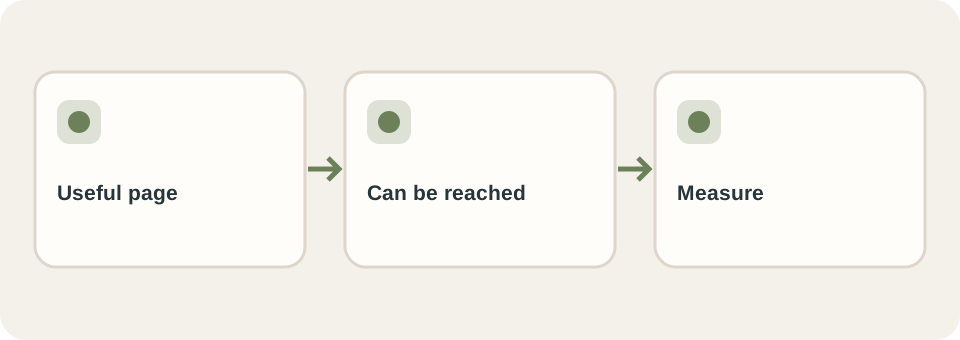
Start website SEO by making each important page useful for a specific visitor question, then check that people and search engines can reach it. Give the page a clear title, understandable content, relevant links and a working next step. Finally, use actual search data to decide what to improve. “SEO-ready” without a list of deliverables or checks is too vague to buy.
Google’s SEO Starter Guide explains that there are no secrets that automatically rank a site first. Search optimization can improve eligibility and understanding, but neither a build nor a sitemap proves indexing or traffic.
Give pages distinct jobs
A service page should explain who the service helps, the work included, useful examples and how to ask a question. A project page should make clear what was actually delivered and what is only a demo. Do not create near-identical pages for many keywords or places if they add no distinct value. Google’s helpful-content guidance asks whether material primarily helps people, not whether it hits a word count.
| Page | Reader’s question | Next check |
|---|---|---|
| Service overview | Is this provider relevant? | Clear scope and route to a specific service |
| Specific service | Does it fit my need? | Evidence, exclusions and contact path |
| Project or example | What does this work look like? | Honest context and source of claims |
These are editorial examples. A business with one service may need fewer pages. Use a content inventory to find where real answers are missing.
Check access and linking
Open a page without signing in, follow navigation and related links, and inspect its canonical URL. Confirm that production robots.txt does not accidentally block the site, important pages do not carry noindex, and a useful sitemap lists public routes. Google’s crawling and indexing documentation separates discovery, crawling and indexing; a page returning 200 is only one technical signal.
On DT Software itself, blog routes and robots settings are part of the release checks. That is an operational example of what to verify, not a claim that these pages already rank. A redesign also needs the old-to-new URL plan if paths change.
Measure before rewriting
If Search Console access exists, review which queries and pages receive impressions and clicks, the time period, and changes to the site during that period. Google’s Search Console performance help defines those metrics; impressions are exposure for your property, not total search demand. Small samples and seasonality need caution. Without data, write down what is unknown and start with obvious usability and access problems.
When comparing website proposals, ask who supplies page content, titles, redirects, analytics setup and post-launch checks. DT Software’s website service can be scoped around specific search foundations and SEO support; no provider can honestly guarantee a ranking.